


Key Takeaways
- "GTM Engineer" is less about a job title and more about a mindset.
- BDRs are already doing much of the work GTM engineers do. They just need the right tools to scale it.
- Empowering BDRs with no-code and AI tools helps teams move faster and respond to market changes in real time.
- You don't need a coding background to get started. Curiosity, basic tech skills, and problem-solving are enough.
- The future of GTM is distributed and collaborative, and BDRs are at the center of it.
GTM Engineer: A New Term, Real Potential
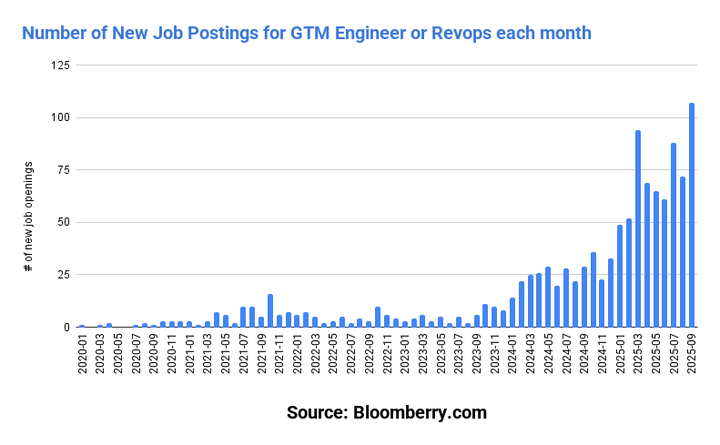
Bloomberry's data shows GTM Engineering Jobs are up 205% year over year. While the term "GTM Engineer" is still new, it is crucial in aligning products with market needs, ensuring seamless product launches and market penetration. This role requires both strategic insight and technical acumen, and the surging job growth underscores how integral GTM is becoming, with AI also increasingly intertwined as seen in usage trends among GTM professionals.
Key Functions of a GTM Engineer:
- Aligning product features with customer needs
- Collaborating across teams for efficient product launches
- Monitoring and optimizing marketing and sales strategies
Key Differences Between RevOps, SDRs, and GTM Engineers by Saleshandy:
| Task | RevOps | SDR | GTM Engineer |
|---|---|---|---|
| Prospecting | Clean CRM data (firmographics, technographics, and intent data) | Manually research leads through tools like LinkedIn or Saleshandy + cold email/call leads | Automate lead sourcing using AI (scrape LinkedIn ➡ enrich with tools like Saleshandy Lead Finder ➡ ️route to a CRM) |
| Routing a Lead | Set up CRM rules to assign leads to reps based on territory/ICP | Follow up manually after the assignment | Build auto-routing workflows (lead scores trigger assignments without human intervention) |
| Creating ICPs | Analyze historical data to define ICPs | Identify which leads convert best | Use AI to automate ICP refinement (adjust criteria in response to real-time conversion data) |
| Sales Outreach | Configure email templates in tools like Saleshandy. | Send 100+ cold emails/day and follow up on the conversations. | Automate multi-channel sequences (email → LinkedIn → SMS) with AI personalization |
| Handoff to AEs | Ensure CRM fields are always up-to-date with the latest data | Pass prospect briefs to Account Executives (AEs) after qualifying leads | Auto-generate handoff briefs (summarize lead interactions from call transcripts) |
| Reducing Churn | Build churn-risk dashboards (If usage drops → alert CSMs) | Manually check in with customers at risk of dropping out | Automate churn prediction and customer retention (For example, analyze support tickets + trigger retention plays) |
| Upselling | Track expansion opportunities in CRM. | Identify upsell chances during calls. | Auto-trigger upsell campaigns (For example, email customers who hit usage thresholds) |
Understand the real shift in GTM work:
The concept first gained attention thanks to Clay, a company that used it to describe advanced users of their go-to-market tools. While the name may have started as part of product positioning, the concept behind it reflects a real shift in how GTM work is done.
- What many call a "GTM Engineer" today often looks like a more technical sales engineer or a no-code builder using tools like Clay, Apollo, or Zapier.
- The danger is not the role itself but how the label can make the work seem out of reach — discouraging BDRs, SDRs, and generalists who are already solving these problems daily.
- As one Redditor noted:
"Oh, it 100% is [made up]. Clay created the job title out of nothing…"
The idea behind GTM engineering is valuable, but it shouldn't feel exclusive. It's about recognizing and empowering the work teams are already doing.
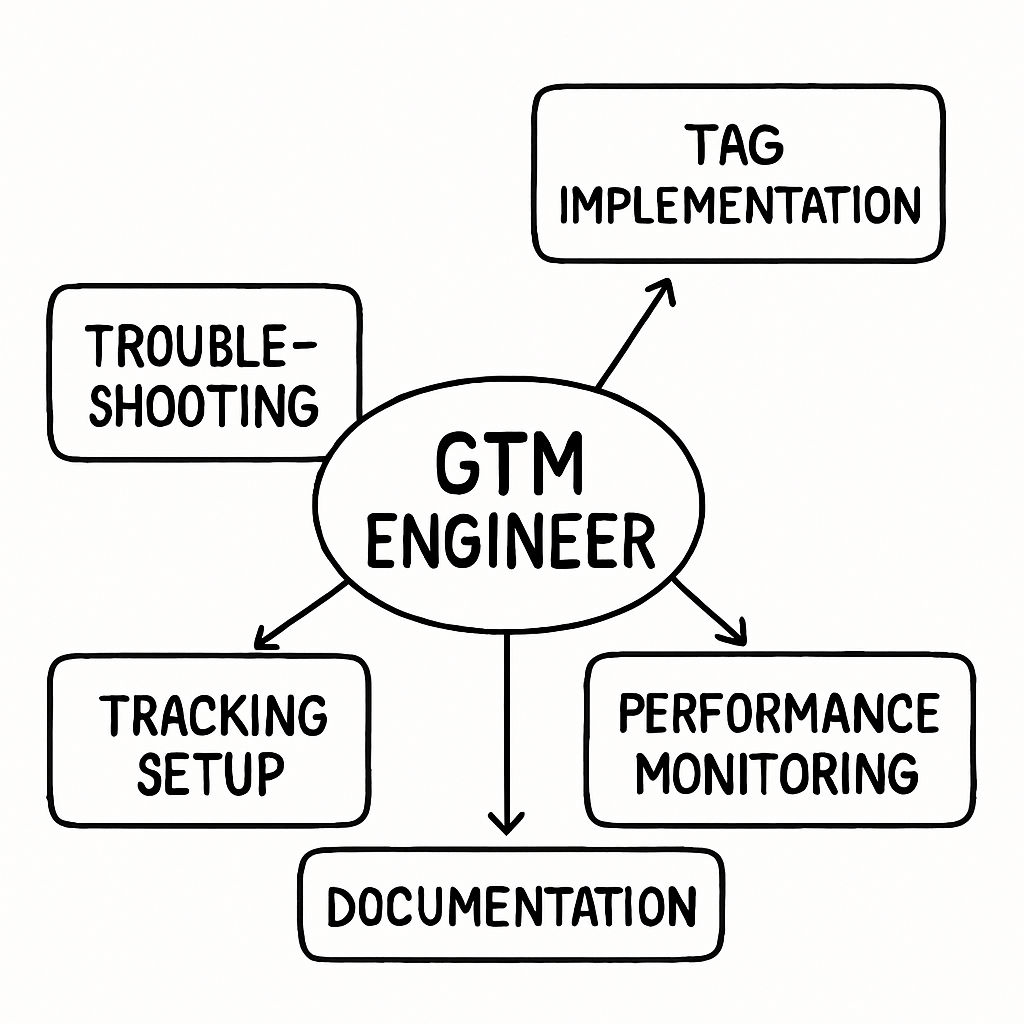
GTM Engineering Is a Team Sport
Modern GTM moves too quickly to rely on one specialist. It's not about waiting for someone else to act. It's about empowering the whole team to adapt and execute fast.
BDRs often engage in customer interactions. This role sharpens their communication skills. They learn about customer needs and pain points. BDRs have a front-row seat to the sales process. They witness market demands firsthand. This knowledge is vital for a GTM strategy.
GTM Work: Why BDRs Matter
| Dimension | Why It Matters | BDR's Advantage | Challenge | Impact |
|---|---|---|---|---|
| Speed | GTM must adapt fast. | React quickly to market shifts. | Specialists slow things down. | More opportunities captured. |
| Market Insight | Feedback shapes strategy. | Hear pain points firsthand. | Insights often stay siloed. | Smarter, faster decisions. |
| Execution | Rapid iteration wins deals. | Launch and adjust campaigns fast. | Bottlenecks delay actions. | Higher conversion and pipeline. |
| Tools & Automation | AI scales workflows. | Use no-code tools easily. | Tools can be complex. | More time for high-value work. |
| Team Mindset | GTM is a shared effort. | Empowered BDRs act fast. | "Wait for experts" slows progress. | Stronger, more agile teams. |
Why should every BDR think like a GTM Engineer:
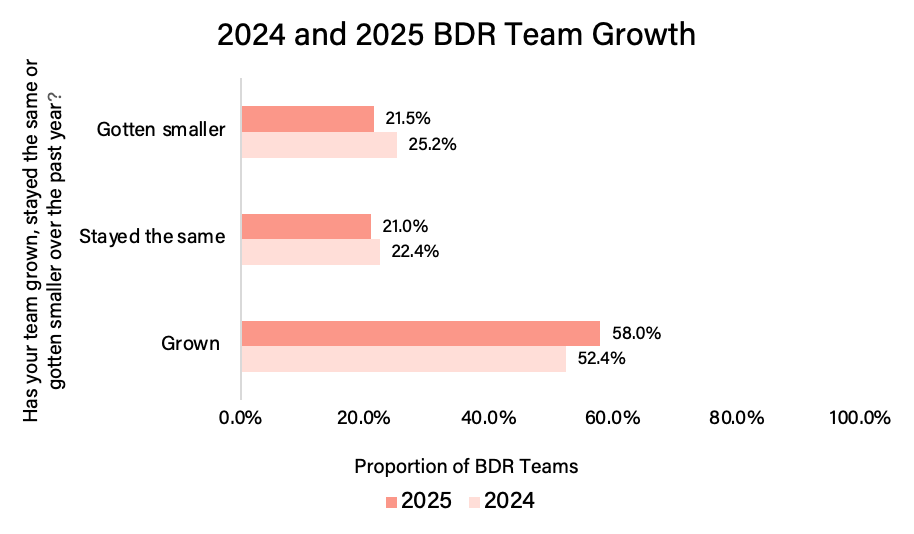
BDR teams are steadily growing shown by 6sense: 75% of BDRs reported no team shrinkage in 2024 (22.4% stable, 54.2% expanded), and 79% said the same from 2024 to 2025 (58% expanded). This rising role in GTM means BDRs need to learn to act as GTM Engineers.
BDRs have natural advantages — they gain frontline customer feedback to shape strategies fast — while GTM Engineers are rare and scaling them causes delays. AI GTM tools are key for BDRs' transition: only with AI can BDRs leverage their strengths, avoid bottlenecks, and drive efficient GTM operations. To be more specific:
- Frontline advantage: BDRs are closest to the market. They hear prospect feedback daily and can use it to shape smarter strategies faster than any centralized team.
- Specialists slow things down: GTM Engineers are rare and hard to scale. Waiting for them delays campaign adjustments and lead generation — and delays mean lost pipeline.
- AI tools help — but not perfectly: Tools like Clay and Apollo promise automation but often feel clunky, expensive, or overly complex. Instead of speeding things up, they can become roadblocks.
The best GTM teams move quickly, and BDRs are in the ideal position to lead that charge.

The Future: BDRs as AI-Native GTM Operators
This is where platforms like Lev8 come in. We don't believe in new titles — we believe in enabling existing roles. Lev8 helps BDRs:
- Automate GTM workflows without code
- Turn real-time insights into action
- Own their go-to-market strategy end-to-end
In an era of AI and data-driven decisions, BDRs shouldn't wait for permission or a new hire. They should run the GTM engine themselves.
Ditch the Title. Keep the Power.
"GTM Engineer" doesn't need to be a job title. It should be a mindset. With the right tools, every BDR can:
- Spot trends as they emerge
- Share market insights that shape strategy
- Build and manage GTM workflows directly
Every BDR will be a GTM engineer — That's what Lev8 strives for. Built for an AI-native era, Lev8 is to empower teams to run GTM workflows automatically, turn prospect insights into action seamlessly, and enlighten every team member to think independently.
❓ FAQ: Becoming a GTM Engineer as a BDR
What skills do I need to become a GTM Engineer? You don't need to be an engineer in the traditional sense. The most important skills are simple and learnable:
- Curiosity: Always ask how things work — and how they could work better.
- Basic tech comfort: If you can use sales tools, you already have the foundation.
- Problem-solving mindset: Enjoy figuring out workflows and improving processes.
- Continuous learning: GTM tools evolve fast — stay curious and keep experimenting.

Can I learn GTM engineering without a technical background? Yes, absolutely. GTM engineering today is more about creativity and process thinking than coding. You can succeed without writing a single line of code:
- Most tools now offer no-code or low-code interfaces with drag-and-drop features.
- Learn through tutorials, online communities, and hands-on practice.
- Experiment with free tools and build small workflows to build confidence.
- Progress naturally — your skills grow quickly as you start connecting tools and automating tasks.
How do AI tools help me in my role as a BDR? AI is your growth accelerator. It handles repetitive work and gives you time back to focus on what matters:
- Automate manual tasks: from lead qualification to list building.
- Analyze market signals: spot trends and prioritize accounts faster.
- Personalize outreach: Lev8 can help craft tailored messages at scale.
- Save time for real conversations: spend more hours building relationships and closing deals.
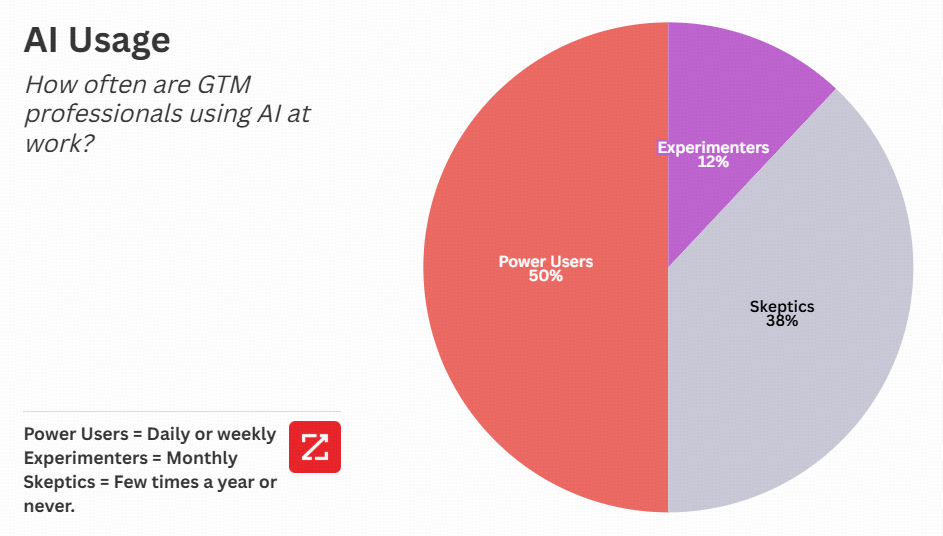
This pie chart, sourced from ZoomInfo, illustrates the AI usage frequency among GTM professionals. "Power Users", who use AI daily or weekly, account for 50%. "Experimenters", using AI monthly, make up 12%. "Skeptics", using AI a few times a year or never, constitute 38%. Evidently, GTM and AI are closely intertwined nowadays, as the majority, including the substantial 50% of power users, are actively integrating AI into their work processes, showcasing a widespread adoption trend within the GTM professional community.
Will learning GTM engineering advance my career? Definitely. GTM skills are among the most in-demand in modern revenue teams. Building them pays off in multiple ways:
- Stand out from other BDRs by mastering high-impact tools and workflows.
- Open doors to new roles in sales, RevOps, and growth operations.
- Increase earning potential as you become more valuable to your team.
- Future-proof your career with skills that grow more important every year.
Get early access to Lev8 here: https://form.typeform.com/to/dsMu4Whd?typeform-source=lev8.com